
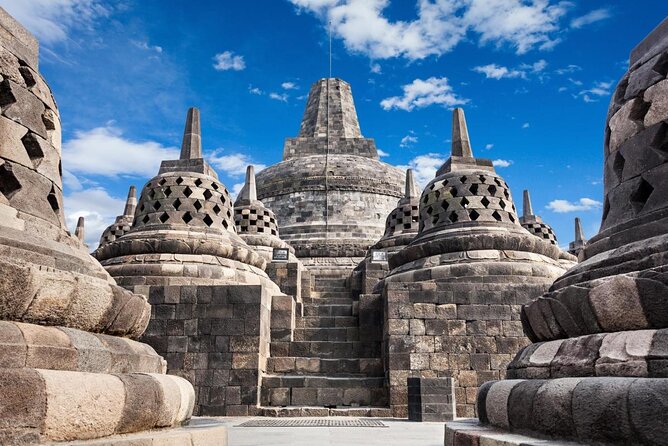
The story of Borobudur Temple Rediscovery explains how an ancient Buddhist monument returned to wider public attention after centuries of decline. Borobudur never vanished completely from local memory, but vegetation, soil, and neglect covered much of the structure. In 1814, the British administration in Java began a major investigation that brought the site into modern archaeological records.
What Happened Before the Rediscovery?
Borobudur served as a Buddhist monument for centuries after its construction in the eighth and ninth centuries. UNESCO states that people stopped using it sometime between the 10th and 15th centuries.
Over time, natural growth and soil covered large parts of the monument. Local communities still knew about the site, and Javanese traditions continued to mention it. However, the temple no longer functioned as a major religious center.
For more historical background, read our guide to important facts about Borobudur Temple. It explains the temple’s history, architecture, Buddhist meaning, and important features.
What Did Thomas Stamford Raffles Do?
In 1814, Thomas Stamford Raffles served as the British Lieutenant-Governor of Java. During a visit to Semarang, he received information about a large ancient monument near Magelang.
Raffles did not personally excavate Borobudur. Instead, he asked Dutch engineer H.C. Cornelius to investigate the site. Cornelius had experience exploring ancient remains in Java.
This distinction matters because local people already knew the monument existed. Raffles helped bring Borobudur to the attention of colonial scholars and officials.
How Did H.C. Cornelius Clear Borobudur?
Cornelius organized around 200 workers to clear the site. They cut trees, removed bushes, and dug away soil that covered parts of the monument.
The work exposed more of Borobudur’s terraces, reliefs, and stone structures. Cornelius later reported his findings to Raffles. This investigation created an important starting point for later documentation and conservation.
The early clearing did not solve every problem. Exposed stone faced weather, drainage issues, and structural risks. Later researchers and engineers had to study the monument more carefully.
What Happened After 1814?
Interest in Borobudur grew during the nineteenth century. Scholars documented reliefs, statues, architecture, and inscriptions. Researchers also uncovered the hidden-foot reliefs in 1885.
The Dutch colonial government later supported a major restoration from 1907 to 1911 under Theodoor van Erp. That project strengthened important sections and reconstructed parts of the upper monument.
Indonesia and UNESCO later launched a much larger restoration effort from 1973 to 1983. The project improved drainage, stabilized the structure, and helped preserve Borobudur for future generations.
Why Does the Rediscovery Matter Today?
The Borobudur Temple Rediscovery changed how scholars and travelers understood ancient Java. It brought international attention to Borobudur’s architecture, Buddhist art, and historical importance.
Today, visitors can explore the monument while learning about its long journey from ancient religious center to World Heritage Site. Travelers who want more historical context can choose a private Borobudur tour from Yogyakarta. A local guide can explain the rediscovery, restoration, reliefs, and spiritual design during the visit.
Conclusion
The Borobudur Temple Rediscovery of 1814 marked the beginning of modern documentation and conservation at the site. Raffles received information about Borobudur, while H.C. Cornelius led the physical clearing work with local laborers.
Their efforts opened a new chapter in Borobudur’s history. Later research and restoration transformed the neglected monument into one of Indonesia’s most important cultural landmarks.
