
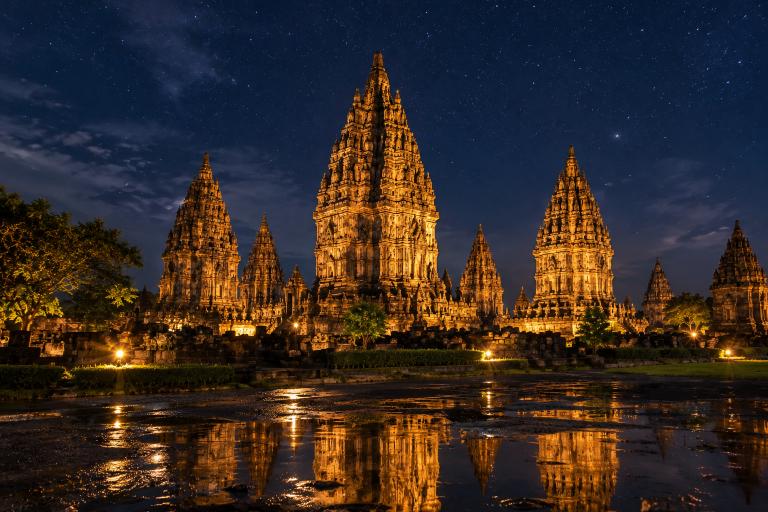
Prambanan Temple is one of the finest examples of Hindu architecture in Southeast Asia. Its towering stone shrines, detailed carvings, and carefully planned layout reflect the advanced knowledge and artistic skill of ancient Javanese builders. For anyone interested in Prambanan temple Hindu architecture, Prambanan offers a remarkable example of sacred design and craftsmanship.
Prambanan was built during the 9th and 10th centuries under the Mataram Kingdom. The complex was designed as a major center of Hindu worship and dedicated to the Trimurti: Shiva, Vishnu, and Brahma. The central Shiva Temple is the tallest structure in the complex, reaching approximately 47 meters. Its pointed tower dominates the surrounding landscape and serves as the spiritual center of the entire site.
The temple complex contains hundreds of structures arranged in concentric zones. The most sacred buildings are placed at the center, while smaller shrines surround them. This layout reflects Hindu cosmology and the idea of a sacred universe centered on divine power. It also demonstrates the advanced planning ability of ancient Javanese builders.
One of the most striking features of Prambanan is its use of volcanic andesite stone. The builders shaped each block carefully and assembled the structures with impressive precision. Many parts of the temple were built without mortar, relying instead on carefully designed joints and interlocking pieces. This technique shows the advanced engineering knowledge of ancient Javanese craftsmen.
The temple towers, known as candi, have tall, pointed spires that resemble sacred mountains. In Hindu tradition, mountains are often seen as places connected to the gods. The shape of Prambanan’s towers may therefore symbolize Mount Meru, the mythical center of the universe in Hindu and Buddhist cosmology. This vertical design gives the complex a powerful and spiritual appearance.
The walls of the main temples are decorated with detailed reliefs from the Ramayana epic. These carvings tell the story of Prince Rama, his wife Sita, and the monkey hero Hanuman. The reliefs present themes of loyalty, courage, sacrifice, and the victory of good over evil. They are considered masterpieces of Hindu-Javanese art.
Prambanan is also known as Candi Roro Jonggrang. This name comes from a famous Javanese legend about a princess who was turned into stone. According to the story, a prince was challenged to build one thousand temples in one night. The princess tried to stop him by creating the illusion of dawn, and as punishment, she was transformed into stone.
The temple complex faced many challenges throughout its history. Earthquakes, volcanic eruptions, and political changes contributed to its decline in the early 11th century. It was rediscovered in the 17th century, and restoration efforts have continued for decades. In 2006, a powerful earthquake in Yogyakarta caused significant damage, requiring further conservation work.
In 1991, Prambanan Temple Compounds was recognized as a UNESCO World Heritage Site. This status highlights the temple’s exceptional architectural value and cultural significance. The recognition also covers nearby temple complexes such as Sewu, Lumbung, and Bubrah.
Prambanan is located about 17 kilometers northeast of Yogyakarta city center, making it easy to reach for travelers. The site can be combined with other major attractions such as Borobudur, Sultan Palace, Malioboro Street, and Mount Merapi.
Prambanan is more than an ancient monument. It is a living symbol of Indonesia’s history, creativity, and spiritual heritage. Its Hindu architecture, towering temples, and sacred atmosphere make it one of the most important cultural sites in Southeast Asia.
