
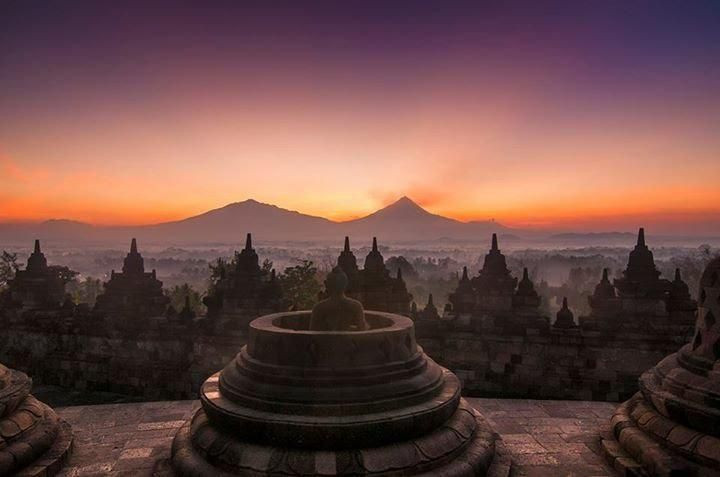
The Borobudur Temple architecture history reveals how ancient builders combined religious ideas, artistic traditions, and structural planning into one remarkable monument. Its terraces, galleries, stupas, Buddha statues, and reliefs create a distinctive architectural form that continues to attract visitors interested in ancient Java.
Borobudur Was Built in Ancient Java
Borobudur emerged during the ancient Javanese period, generally associated with the eighth and ninth centuries. Its development is connected with the Sailendra Dynasty and the Buddhist traditions that flourished in Central Java.
Constructing such a large monument required careful organization. Builders had to shape volcanic stone and arrange it into terraces, stairways, galleries, walls, and upper platforms.
The resulting structure demonstrates the advanced craftsmanship of ancient Javanese builders.
Its Design Combines Square and Circular Forms
One of the defining characteristics of Borobudur is the transition from square to circular architecture.
The lower levels consist of square terraces surrounded by galleries. Above them, three circular platforms create a noticeably different architectural environment.
This change in shape produces a gradual visual transition as visitors climb toward the central stupa.
Reliefs Became Part of the Architecture
The Borobudur Temple architecture history also includes the development of its extensive relief carvings. Artists carved thousands of scenes directly into the stone walls and balustrades.
The reliefs portray Buddhist narratives as well as people, animals, buildings, plants, and activities associated with daily life.
Because the carvings follow the walking galleries, visitors experience them as part of the architecture rather than as separate works of art.
Buddha Statues Were Integrated Into the Design
Buddha statues appear throughout several levels of the monument. Many figures sit within niches along the square galleries, while others are positioned inside the perforated stupas on the upper circular platforms.
Their placement creates repetition and balance across the monument.
The statues also demonstrate how sculpture became an important architectural element rather than simply an additional decoration.
For travelers who want to explore more about Borobudur’s history, architecture, Buddhist meaning, and interesting details, this Borobudur facts guide provides a broader overview.
The Upper Platforms Emphasize Stupas
The three circular platforms contain rows of perforated stupas arranged around the central stupa.
Their repeated forms create a strong geometric pattern. The open arrangement also contrasts with the detailed galleries below.
This architectural transition gives the upper levels a different atmosphere and emphasizes the central structure at the summit.
Architecture Reflects Buddhist Concepts
Borobudur’s design is closely connected with Buddhist ideas. Its various architectural sections are traditionally understood as representing stages within Buddhist cosmology.
The movement from the lower galleries toward the upper platforms creates a physical progression through these sections.
Architecture therefore serves both practical and symbolic purposes.
The Monument Experienced Historical Changes
Borobudur’s architecture survived through many historical periods. The monument eventually experienced decline and neglect, allowing vegetation and natural conditions to affect sections of the structure.
Later rediscovery and conservation efforts brought renewed attention to its architectural importance.
Restoration work helped protect the terraces, reliefs, statues, and stupas that define the monument today.
Why Its Architecture Remains Important
The Borobudur Temple architecture history demonstrates how ancient builders combined structure, art, religion, and movement. The square terraces provide detailed galleries, while the circular platforms create a more open environment near the summit.
Travelers who want to visit Borobudur and other destinations around Central Java can also explore Borobudur Tours.
Understanding this architectural development can make a visit more meaningful. Borobudur is not simply a large stone monument. Its design reflects centuries of craftsmanship and demonstrates how architecture can communicate cultural and religious ideas.
